
Multiphase Carbon and Water Determination
Advanced Thermal Profiling for Accurate Phase Identification


Overview
LECO RC612 delivers precise carbon and water determination in a variety of metallic, geologic, and industrial materials using advanced combustion technology and infrared detection. Designed for laboratories focused on quality control and research, it ensures accurate results for applications such as verifying raw material purity, monitoring process consistency, and supporting product development.
With a robust high-temperature furnace, automation-ready features, and user-friendly operation, the RC612 streamlines workflow while reducing operator involvement. Its reliability and repeatability make it an essential tool for industries where carbon content impacts performance, helping to improve productivity, lower operating costs, and maintain compliance with stringent standards.
Why Choose the LECO RC612

Multiphase Carbon Analysis
Quantify total carbon and water in a sample and identify the source of different carbon types in that sample. The RC612 uniquely distinguishes surface, free, organic, and inorganic carbon during analysis, which traditionally requires multiple methods. This gives a complete carbon profile, including hydrogen-as-moisture, from a single run.
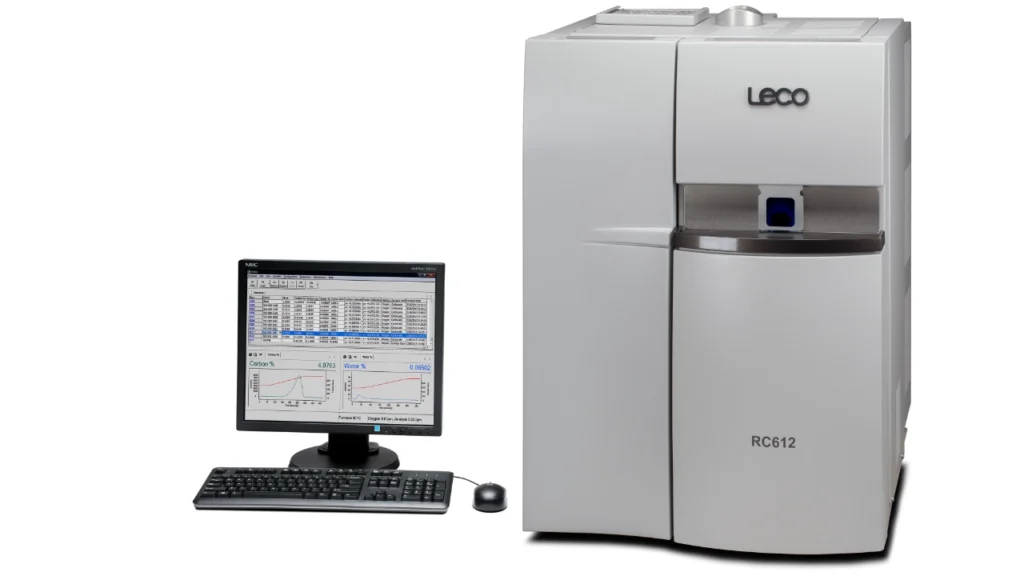
Simultaneous Carbon & Water Determination
Measure carbon content and water content together, unlike any other analyzer. The RC612’s furnace control allows programming oxidizing or inert atmospheres sequentially, so carbon (as CO₂) and water (H₂O) are detected in the same analysis. This two-in-one approach saves time and provides additional insight (e.g. confirming organic carbon by the H₂O released) without separate tests.

Easy & Convenient Operation
Small footprint design and user-friendly software make the RC612 simple to integrate into any lab. The operating software features an intuitive interface for routine or research use, and on-board diagnostics continuously monitor system health to minimize downtime. Most samples can be analyzed as is, with minimal or no sample prep, further streamlining the workflow.

Fast, Robust Analysis
Achieve quick cycle times and optimized carbon peak separation, thanks to advanced furnace algorithms that rapidly ramp and cool the furnace with minimal overshoot. An integrated afterburner (secondary furnace at ~850 °C) and catalysts ensure complete combustion of all evolved gases, yielding reliable results even for difficult matrices. This robust design and enhanced instrument construction give the RC612 exceptional durability and analytical consistency. An optional autoloader further increases laboratory throughput.
Instrument Applications
Featured Application Notes
Determining Total Organic Carbon with Temperature Dependent Differentiation
Determining Total Organic Carbon with Temperature Dependent Differentiation

Determination of Moisture in Welding Flux
Determination of Moisture in Welding Flux
Determination of Surface Carbon on Aluminum Sheets, Rods, and Wire
Determination of Surface Carbon on Aluminum Sheets, Rods, and Wire

Surface Carbon on Steel Sheet and Rod Samples
Surface Carbon on Steel Sheet and Rod Samples
How the RC612 Works
The RC612 multiphase carbon and water determinator quantifies the carbon and hydrogen present in various organic and inorganic samples and identifies the source of several types of carbon content.
The instrument features an innovative furnace control system, which allows the temperature of the dual-stage furnace to be programmed from near-ambient to 1100 °C.
Depending on the application, multiple furnace steps can be programmed by the operator, and the furnace purged with oxygen or nitrogen, creating oxidizing or inert conditions in which the carbon and water present is combusted or reacted. An afterburner furnace (nominally set to 850 °C) and a secondary oxidation catalyst are included in the flow path to ensure full combustion/reaction of all evolved components. Infrared detection is used to quantify the result either as a weight percentage or as a coating weight (mg/in2).
When combusted in an oxidizing atmosphere (O2), all forms of carbon (except some carbides, such as SiC) are converted to CO2. In contrast, organic forms of carbon produce both H2O and CO2. Thus, the presence of organic carbon may be verified by finding coinciding peaks in H2O and CO2. Water and carbonate are detected when the sample is combusted in an inert (N2) atmosphere, with the furnace catalyst temperatures at 120 °C. In this mode, organic carbon is normally not detected. Additional sources of carbon can often be differentiated by the temperature at which they oxidize or volatilize.
A slow ramping temperature program from 100 °C to 1000 °C at 20 °C/min can be used for the analysis of unknown samples. This type of analysis can be used to indicate the temperatures at which the differing forms of carbon are oxidized, thereby enabling the operator to optimize the furnace temperature program to provide more rapid quantitative results for each form of carbon present in this sample type.
Applicable Methods
LECO RC612 adheres to these approved methods.
- AWS A4.4M:2001 Moisture Content of Welding Fluxes and Welding Electrode Flux Coverings
- ISO 10694 Soil Quality – Determination of organic and total carbon
Instrument Support
Ensure reliable instrument performance with extensive support, training, and maintenance services. Need tailored support for your elemental analyzers? Our experts are standing by.
Events
Webinars, Showcase, Conferences and Tradeshows




 English
  Spanish
  Japanese
  German
  French
  Portuguese