

The Fast-Track to Chemical Insights
ChromaTOF Tuile
Advanced GCxGC Data Comparison
ChromaTOF Tile is LECO’s advanced tool for rapid comparison of comprehensive two-dimensional gas chromatography (GCxGC) data, designed to help laboratories move from raw data to confident conclusions faster than ever. By segmenting chromatograms into structured retention‑time “tiles” and applying powerful statistical tests, Tile highlights meaningful chemical differences between samples—making it ideal for discovery workflows, quality investigations, and complex multi‑sample studies.
ChromaTOF Tile Benefits
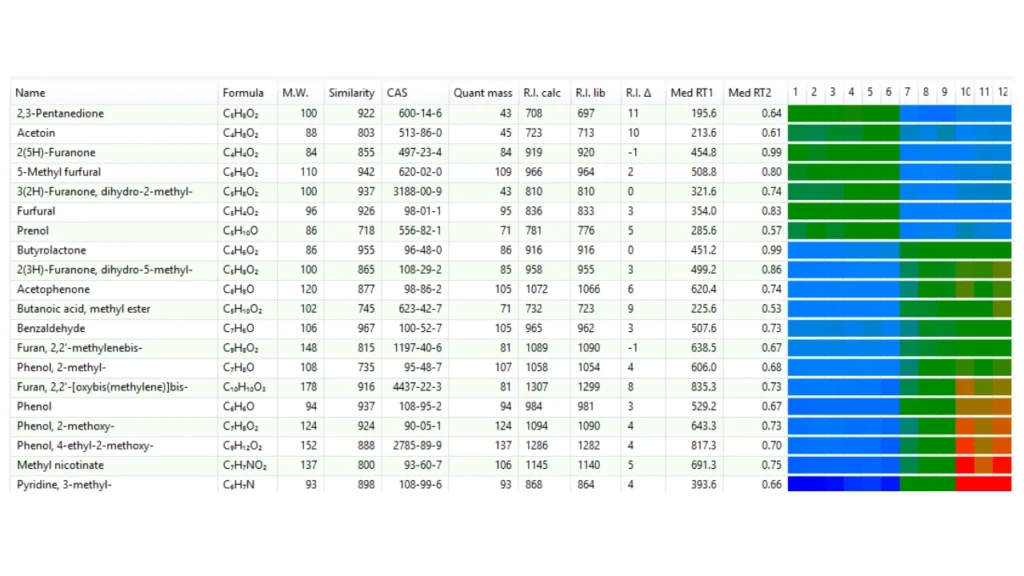
Rapid Differential Analysis
Tile efficiently compiles and compares GCxGC datasets, surfacing statistically significant features across samples or groups. Analysts spend less time searching for differences and more time understanding what they mean.
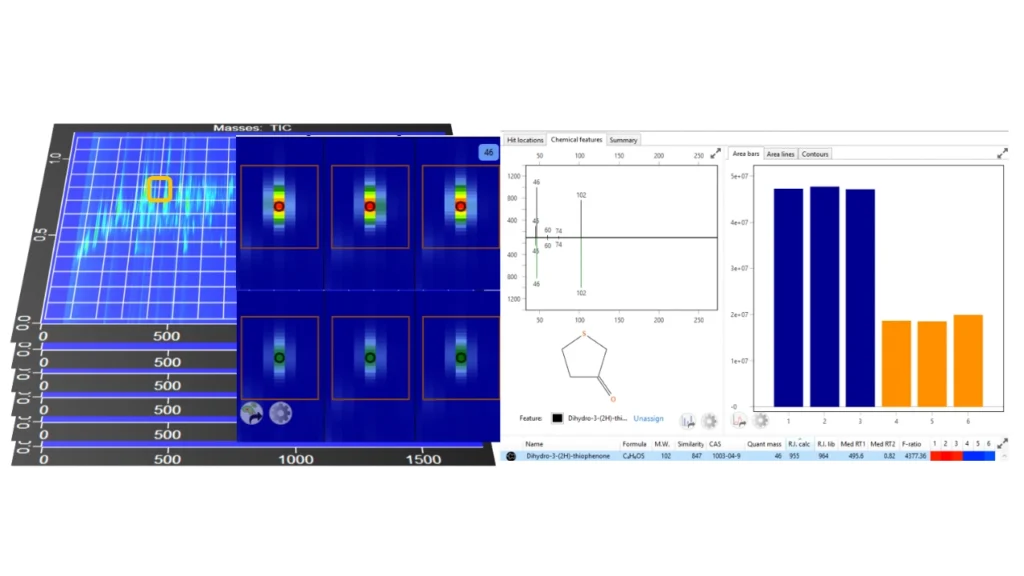
Handle Complex, High‑Dimensional Data
Large, information‑dense chromatograms are automatically broken into manageable retention‑time tiles, simplifying interpretation and enabling efficient identification of regions with the greatest variance.
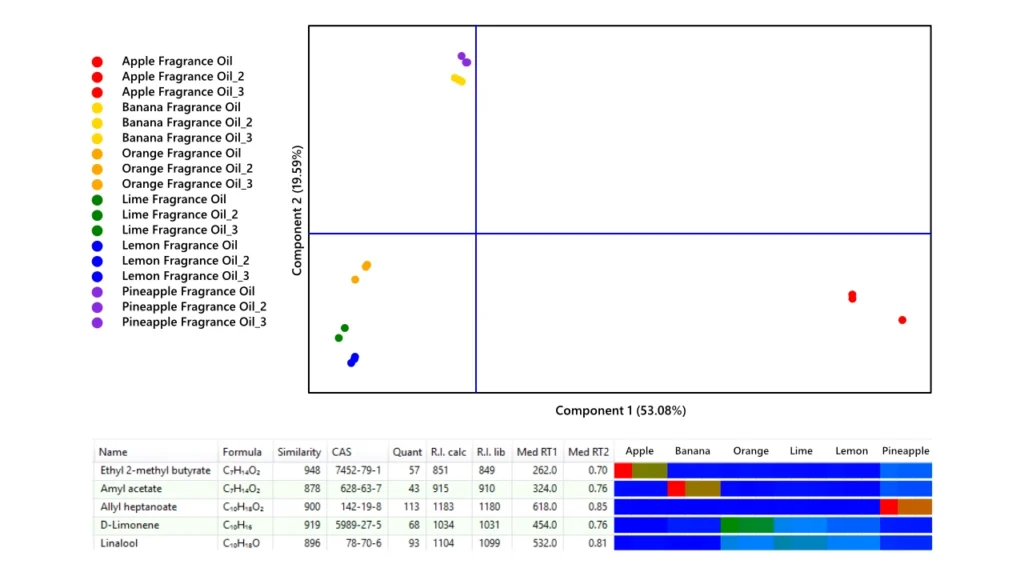
Built‑In Statistical Tools
Tile incorporates powerful statistic tests such as Fisher Ratio, Coefficient of Variation, and Fold Change, which help highlight chemical differentiators under different study designs—whether samples have defined groups, undefined groups, or no replicates.

Flexible for Diverse Workflow
Whether used with GCxGC‑MS or GCxGC‑FID data, Tile complements standard ChromaTOF software and integrates easily into existing workflows for discovery, quality control, and targeted follow‑up analysis.
ChromaTOF Tile Statistical Methods

Fisher Ratio
Ideal for datasets with defined groups and replicates; highlights class‑to‑class differences while minimizing within‑group variance. Perfect for biomarker discovery and source comparison.

Coefficient of Variation
Best for datasets without defined sample groups; reveals underlying chemical signatures and differentiating features. Useful for blind studies or complex screening experiments.

Fold Change
Designed for datasets without replicates; rapidly identifying major chemical differences, ideal for time‑sensitive investigations like product failures or off‑odor identification.
Notes d'application

Différenciation statistique des spiritueux « baijiu » à l'aide de la technique SPME-GCxGC-TOFMS et du logiciel ChromaTOF Tile
Différencier les sirops d'érable réguliers et vieillis en fût
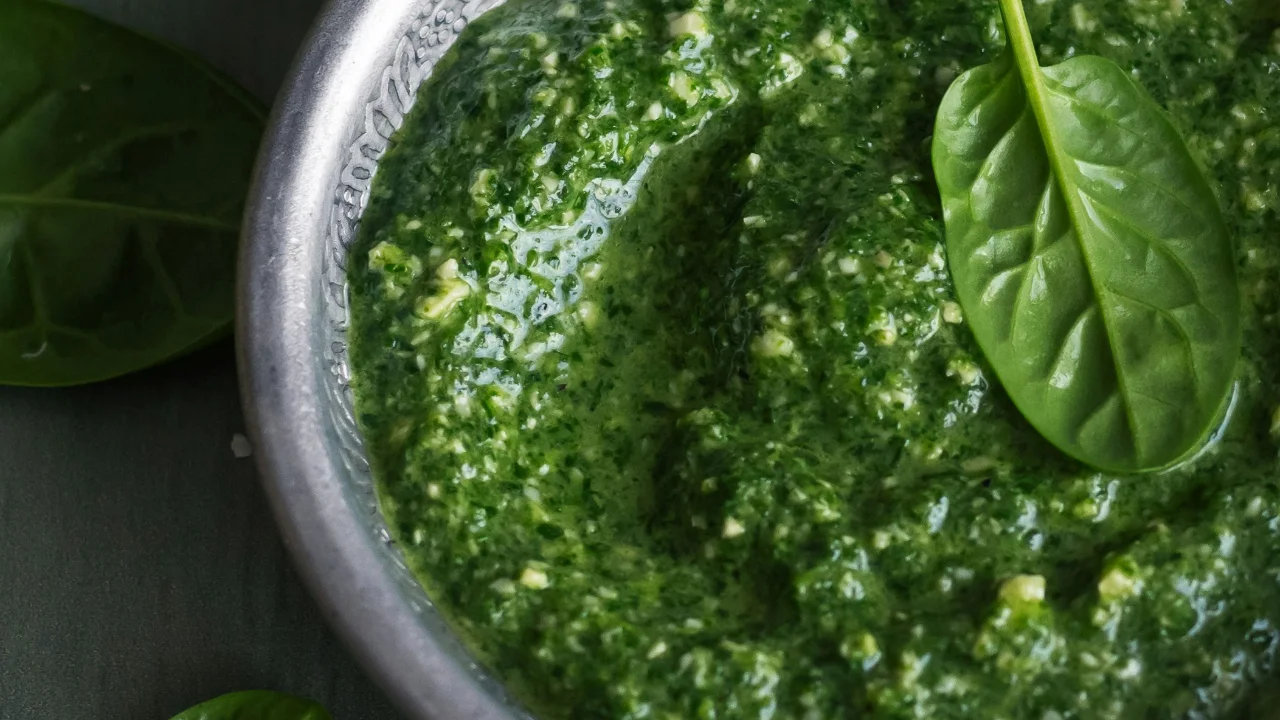
Différenciation statistique des produits à base de pesto à l'aide de la technique SPME-GCxGC-TOFMS et du logiciel ChromaTOF Tile
How ChromaTOF Tile Works
LECO sought strategies to bypass the tedious task of manual GCxGC contour plot comparison, freeing analysts to pursue the next project or rapidly progress key research goals. Traditional peak finding and peak table filtering wouldn’t be fast enough, and couldn’t easily differentiate injection variability from real sample chemistry differences.
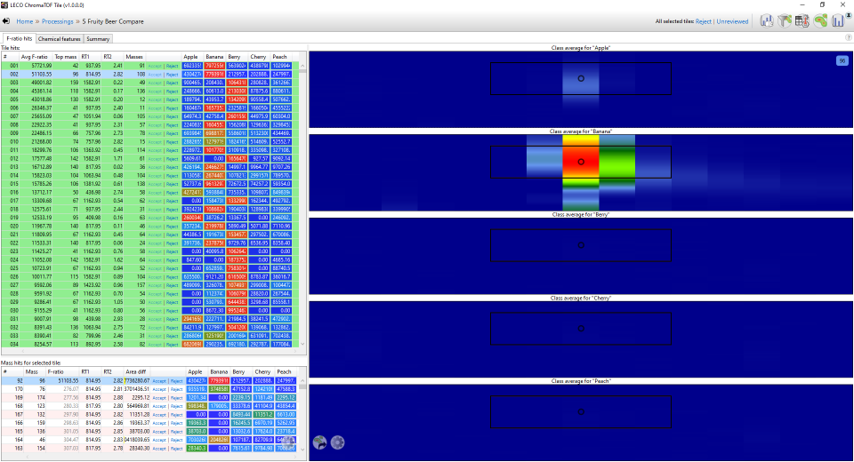
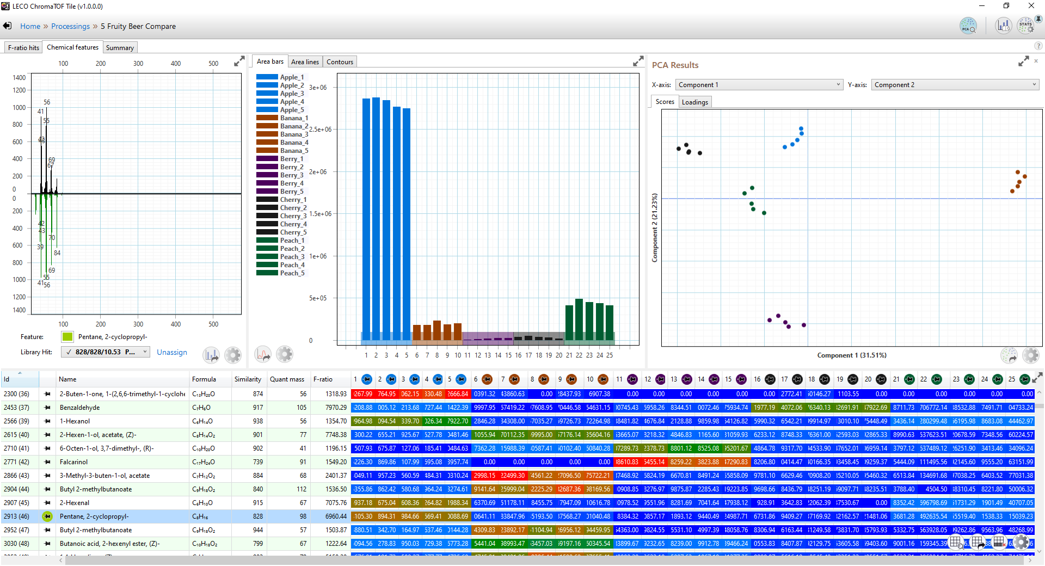
In collaboration with Dr. Robert Synovec’s research team, LECO developed a region-based approach to identifying features in GCxGC contour plots. Raw MS data is segmented by “tiles” – small rectangles defined by retention times – and tiles with unique m/z fragments are identified in the samples. These tiles can then be rapidly compared with those in other samples, creating a heatmap of tile intensity that direct analysts’ attention to characteristic features of a sample or group of samples.
References
Enhanced GCxGC-TOFMS Biomarker Discovery
Fisher Ratio Analysis GCxGC–TOFMS using Null Distribution Approach
Receiver Operating Characteristic Curve Optimization within GCxGC-TOFMS
Improved Feature Selection Analysis in GCxGC-TOFMS
Chemical Characterization of Acid Alteration of Diesel Fuel
Tile-based Fisher Ratio Analysis using Yeast Metabolome Dataset
Foire aux questions
What instruments are compatible with ChromaTOF Tile?
ChromaTOF Tile supports all LECO GCxGC TOF-MS instruments, including Pegasus BTX 4D, Pegasus GC-HRT 4D, and earlier 4D models.
What makes Tile different from the standard ChromaTOF?
While ChromaTOF handles full data processing and deconvolution, ChromaTOF Tile specializes in rapid differential analysis, using tiled retention windows to spotlight key chemical differences instead of individual peaks.
How does Tile handle retention-time shifts?
ChromaTOF Tile’s grid-based alignment compensates for normal chromatographic variation, enabling accurate comparisons even across runs or instruments.
Does Tile require previous peak identification?
No. ChromaTOF Tile works directly on raw or nominalized GCxGC data, making it ideal for non-targeted workflows and early-stage exploration.
Which statistical method should I use?
Fisher Ratio: Defined groups with replicates
Coefficient of Variation: Undefined groups or exploratory studies
Fold Change: No replicates; rapid insights needed
Puis-je exporter les résultats ?
Oui, tous les tableaux et graphiques peuvent être exportés pour des rapports, des publications ou une analyse statistique plus poussée.
Une formation est-elle disponible ?
Oui ! Pour vous aider à démarrer rapidement, les clients peuvent accéder à des tutoriels vidéo à la demande, étape par étape, couvrant les fonctionnalités clés et les tâches courantes. avec LECOLearn.
Quelles options de licence sont disponibles ?
ChromaTOF est disponible sous forme d'essai de 90 jours, d'abonnement annuel ou de licence perpétuelle sur clé USB.
Comment mettre à jour mon logiciel ChromaTOF ?
Visiter LECOsoftware.com pour télécharger les versions les plus récentes de tous les logiciels LECO.
 English
  Spanish
  Japanese
  German
  French
  Portuguese