

Glow Discharge Optical Emission Spectrometers
LECO GDS900 & GDS950 Spectrometers

Einführung
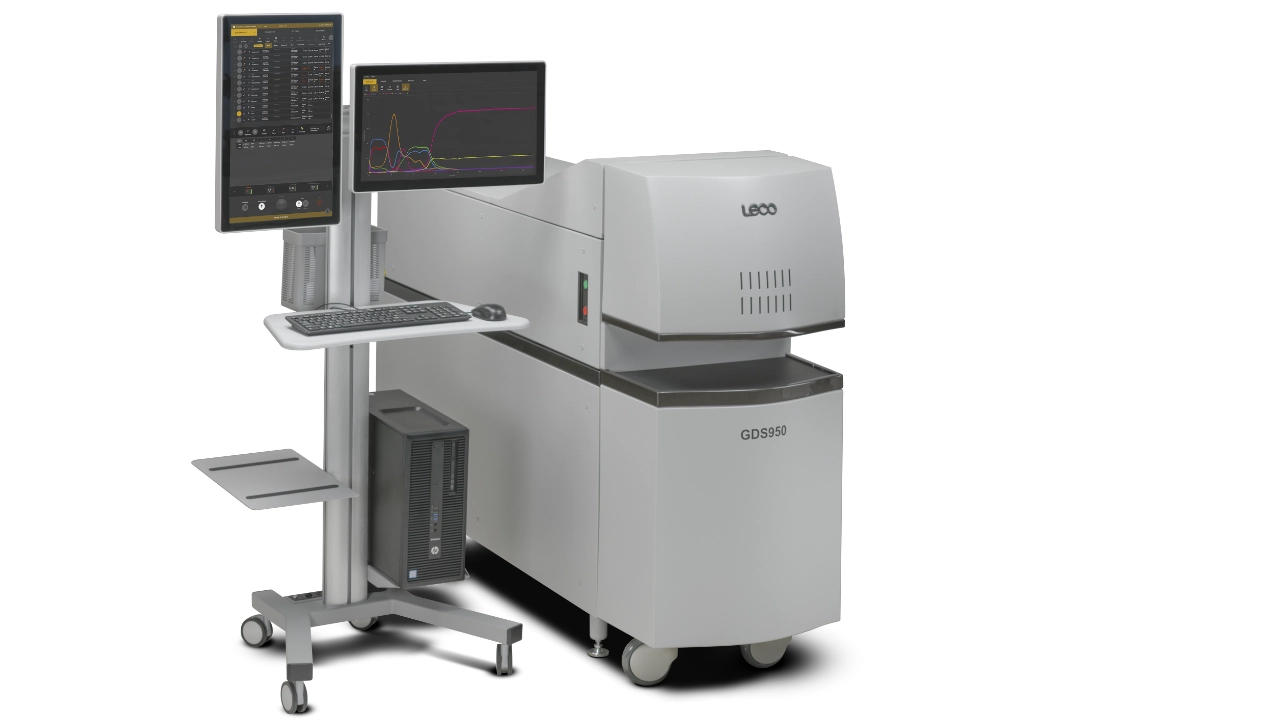
The LECO GDS900 Glow Discharge Spectrometer delivers fast, accurate elemental analysis for routine metals testing and surface characterization. Designed for foundries, metal producers, and quality control laboratories, it provides reliable bulk composition analysis along with coating and surface layer evaluation, including applications such as galvanizing and other metallic treatments. Advanced glow discharge technology and high-resolution CCD detection enable rapid results with excellent repeatability across a wide range of metallic materials.
For laboratories requiring greater analytical flexibility, the LECO GDS950 Glow Discharge Spectrometer expands capabilities with enhanced spectral resolution, broader elemental coverage, and advanced application support. Its dual DC/RF source enables analysis of both conductive and non-conductive materials, including coatings, ceramics, glass, and complex multilayer structures. Combined with comprehensive depth profiling and surface-to-substrate characterization, the GDS950 provides a powerful solution for demanding research, development, and advanced materials applications.
Why Choose LECO GDS Series
True Bulk Accuracy for Metals
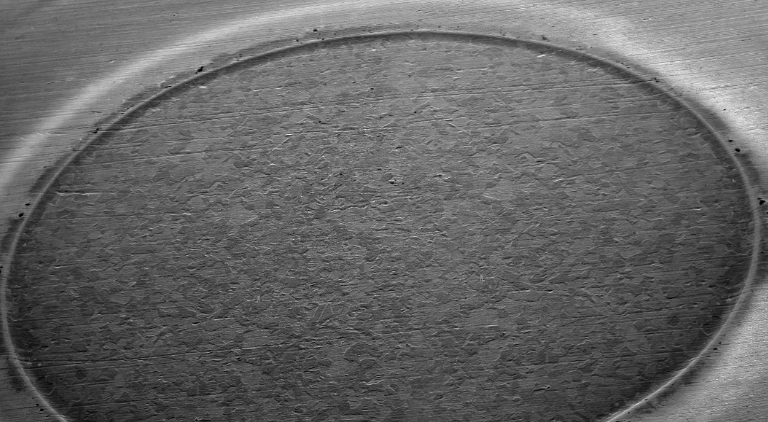
The GDS900 and GDS950 deliver precise bulk elemental analysis through glow discharge technology, where material removal (sputtering) and elemental excitation occur in separate, controlled processes. This unique approach minimizes the influence of microstructure, grain boundaries, inclusions, and other metallurgical history effects that can impact traditional spark OES measurements. The result is bulk compositions that more accurately represent the material itself, rather than localized metallurgical features.

Simplified Setup, Greater Confidence
Glow discharge produces clean, high-resolution spectra with reduced spectral interferences across a wide range of materials. Eliminating the need for type standardization simplifies method setup and enables more confident analysis of unknown alloys, helping laboratories achieve accurate results without first identifying the material grade.
Analyze More, See More
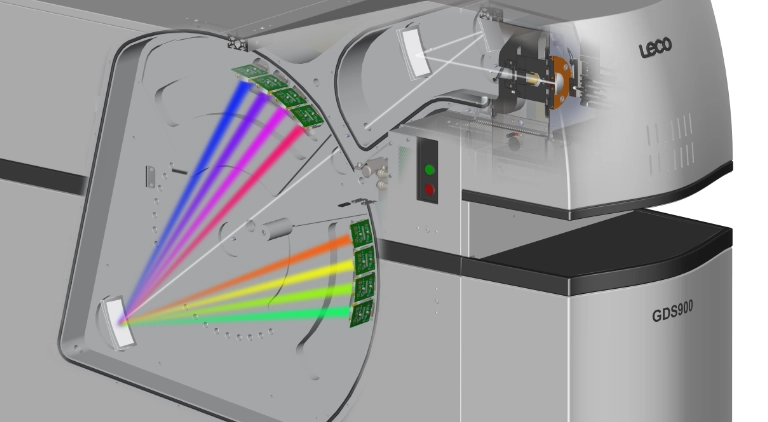
Advanced CCD array detection captures the full emission spectrum simultaneously, providing the flexibility to select optimal analytical lines for each element and application. The result is highly accurate elemental analysis across a broad range of materials, concentrations, and alloy compositions, with the confidence to tackle both routine and challenging samples.
Unmatched Versatility
The dual-mode DC/RF lamp (GDS950) expands your capabilities beyond metals to non-conductive materials like coatings, glass, and ceramics. Switch modes in software—no hardware changes required—for effortless depth profiling and advanced surface analysis.
Geräteanwendungen
Kernanalysen
Anwendungshinweise

Zusammensetzungs-Tiefenprofilanalyse von verzinktem Stahl
Massenanalyse einer Blankstahlprobe, entnommen mit einer Tauchprobenkelle

Massenanalyse von niedrig legierten, Cr-Mo, Automaten- und Austenitischen Hochmanganstählen

Massenanalyse von Gusseisen
How Glow Discharge Spectrometers Work
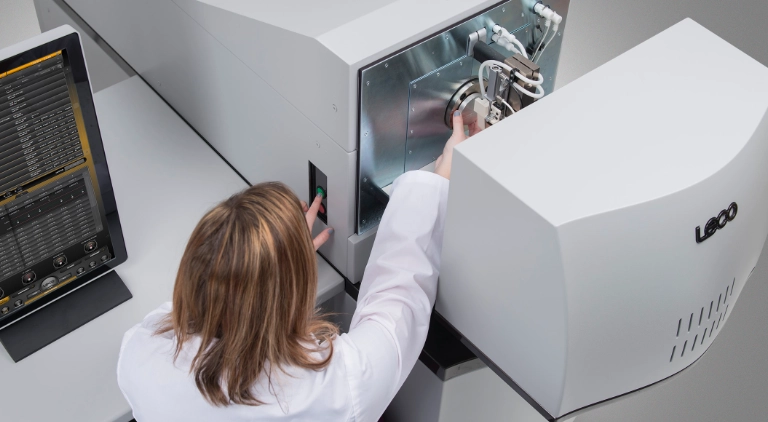
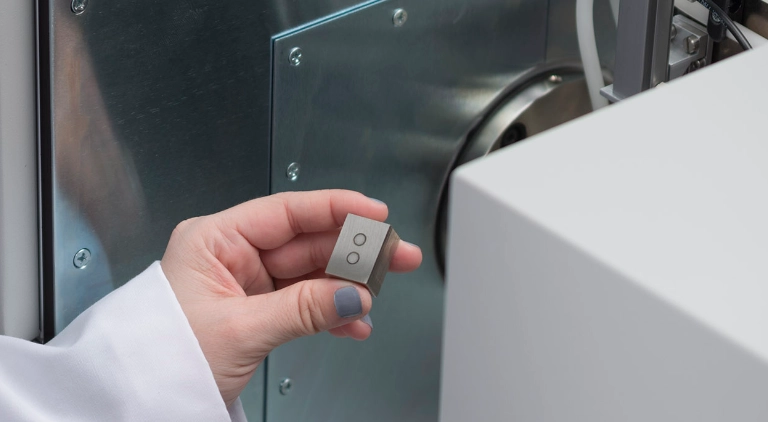
Glow Discharge Spectrometry (GDS) is a high-performance form of Optical Emission Spectroscopy (OES) used for the rapid elemental analysis of solid samples. The process begins by mounting a flat sample onto a glow discharge source. Once the source is evacuated and backfilled with argon, an electric field is applied to create a stable, self-sustained plasma.
Inside this plasma, argon ions are accelerated toward the sample surface. Through a process called cathodic sputtering, these ions eject surface atoms into the plasma, where they collide with energetic electrons and become electrically excited. As these atoms relax, they emit photons at unique wavelengths—the “spectrochemical signature” used in optical emission spectroscopy to identify specific elements.
A high-resolution spectrometer uses CCD arrays to record these OES signals. Because the light intensity is proportional to the concentration of the atoms, the system can precisely quantify the sample chemistry by calibrating known standards.
A primary advantage of GD-OES is its ability to generate a Compositional Depth Profile (CDP). By measuring the emission signals continuously as the plasma sputters deeper into the material, GDS uniquely validates the entire composition in a single run. This provides a detailed map of both external surface treatments (coatings) and the underlying internal “bulk” alloy, making it an essential tool for material validation.
Instrumentendetails
Merkmale
Modelle
Modellvergleich
Optionen
Anwendbare Methoden
LECO Glow Discharge Spectrometers adhere to diese genehmigten Methoden.
- ASTM E2994 Analysis of Titanium and Titanium Alloys by Glow Discharge Atomic Emission Spectrometry
- ISO 19272 Low alloyed steel – Glow discharge optical emission spectrometry
- ISO 11505 General procedures for quantitative compositional depth profiling by glow discharge optical emission spectrometry
- ISO 14707 Glow discharge optical emission spectrometry (GD-OES)
- ISO 16962 Analysis of zinc- and/or aluminum-based metallic coatings by glow-discharge optical-emission spectrometry
- ISO 25138 Analysis of metal oxide films by glow discharge optical emission spectrometry
Instrumentenunterstützung
Ensure reliable instrument performance with extensive support, training, and maintenance services. Need tailored support for your glow discharge spectrometers? Our experts are standing by.
Ereignisse
Webinare, Präsentationen, Konferenzen und Messen




 English
  Spanish
  Japanese
  German
  French
  Portuguese