
Published on
Streamlining Biofuel Proximate Analysis
Process up to 19 Samples in One Automated Run

The growing demand for renewable energy has increased the importance of accurate biofuel characterization. Biomass feedstocks and finished fuels must be carefully analyzed to ensure quality, efficiency, and compliance with international standards. LECO analytical instrumentation supports this work through automated and highly reliable analytical technologies. traditional manual gravimetric testing—relying on a slow conveyor belt of drying ovens, muffle furnaces, and cooling desiccators—creates significant laboratory bottlenecks.
The LECO TGA801 thermogravimetric analyzer eliminates these manual steps by providing an automated alternative for the determination of moisture, volatile matter, and ash content in solid fuels. By utilizing an internal automated balance and a rugged ceramic turntable, the system can analyze up to 19 samples simultaneously. It combines all three proximate analysis parameters into a single automated run, significantly improving laboratory throughput, reducing operator hands-on time, and maximizing reproducibility across diverse sample matrices.
Replacing Manual ISO 18134, 18122, and 18123 Methods with Macro TGA
To validate the performance of the automated TGA801 system against conventional laboratory standard operating procedures, comprehensive comparative studies were conducted using internationally recognized ISO reference methods:
- Moisture Determination: Compared against the oven-drying procedures of ISO 18134
- Ash Content Analysis: Compared against the high-temperature furnace workflows of ISO 18122
- Volatile Matter Evaluation: Compared against the time-dependent heating criteria of ISO 18123
While these international standards traditionally prescribe manual, multi-step procedures, they permit the use of automated macro thermogravimetric instrumentation if equivalent analytical performance can be demonstrated.
The comparison study evaluated a broad range of challenging materials, including wood pellets, peat, coal, plastics, and waste-derived fuels (RDF). The moisture and ash results generated by the TGA801 showed extremely close agreement with the manual ISO reference methods. This tight correlation confirms that switching to an automated macro TGA provides the exact same data reliability as conventional, labor-intensive methods while substantially reducing labor requirements and human error.
Correlating Volatile Matter Data
For volatile matter analysis, both traditional ISO procedures and macro TGA methods measure sample mass loss during a strictly timed, fixed incubation period at 900 °C. However, a key technical distinction exists between the two workflows: the automated TGA method introduces an additional, controlled heating ramp from the initial moisture determination step (at approximately 105 °C) up to the final high-temperature volatile matter threshold.
Despite this procedural difference in heating rates, the resulting data demonstrates excellent agreement between automated and manual workflows.

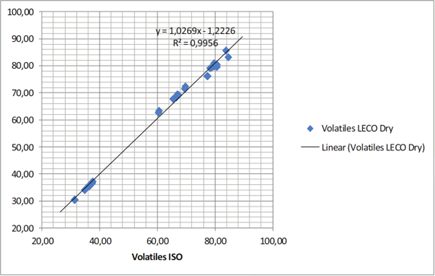
Tests performed with wood pellets revealed a strong linear relationship between the manual ISO reference methods and the automated TGA program, achieving an R2 value of approximately 0.94 (image above, left). The maximum deviation observed across all test matrices was a mere 1.06%, while the average difference between the two analytical methods settled at approximately 0.1%. These correlation results confirm the ability of the TGA801 to deliver highly accurate, repeatable volatile matter measurements of complex biomass and alternative fuel matrices.
Operational Advantages of Automated TGA Analysis
Transitioning from traditional manual workflows to integrated macro TGA testing provides critical operational benefits for industrial testing, contract laboratories and research facilities:
- High Sample Throughput: Simultaneous multi-sample testing handles up to 19 samples in a single sequence.
- Reduced Labor Overhead: Fully automated workflows eliminate manual transfer steps, crucible cooling periods, and operator calculation errors.
- Unified Proximate Analysis: Continuous determination of moisture, ash, and volatile matter occurs in a single, unattended software run.
- ISO-Compliant Accuracy: Strong data agreement with reference methods without requiring complex, matrix-specific calibrations.
- Enhanced Data Integrity: Direct integration with laboratory information management systems (LIMS) improves data security and audit tracking.

Upgrade Your Biofuel Characterization Workflows
Modern biofuel characterization demands analytical methods that keep pace with high-volume production without sacrificing data quality. Beyond automated proximate analysis, a comprehensive testing workflow requires precision at every stage—from calorific value determination via oxygen bomb calorimetry to elemental carbon, nitrogen, and sulfur determination.
The LECO TGA801 demonstrates that automating your thermogravimetric testing does not mean compromising on regulatory compliance. By combining moisture, ash, and volatile matter into one seamless, automated sequence, your laboratory can safely reduce labor hours, eliminate processing bottlenecks, and achieve full confidence in your data.
Are you ready to see how macro thermogravimetric automation fits into your laboratory’s workflows?
Learn more about the LECO TGA801 or contact our application specialists to schedule a data comparison for your specific sample matrices.

 English
  Spanish
  Japanese
  German
  French
  Portuguese