
Published on
Reliable Helium Alternatives for Laboratory Analysis

Labs that rely on helium gas are facing a major crisis…unless they have LECO instruments. Due to the military conflict in the Middle East, Qatar’s Ras Laffan Industrial City, the world’s largest helium production hub, providing one-third of the world’s helium, has shut down operations. To make matters worse, the Strait of Hormuz, the shipping lane used to export helium, has also been closed, meaning even pre-filled helium containers are stuck with no viable route to customers. Naturally, the price of helium has now risen dramatically; most spot prices have doubled. A critical scarcity issue is looming as the world must now operate on roughly 5.2 million cubic meters per month less of helium.
Why Helium Cost and Supply Matters to Labs
Although many people may recognize helium as the gas that fills party balloons, it plays a critical role in much more serious matters. Helium has unique properties, like an extremely low boiling point, inertness, and high thermal conductivity, which makes it indispensable in several high-tech applications.
For example, research labs may use helium as a carrier gas when performing elemental analyses or gas chromatography-mass spectrometry, which is used to separate and identify chemical compounds in samples. But research labs are often government-funded and run under strict budgets, so the price hike on helium could mean labs have to pause their research until everything falls back under control, which could be months or longer. Even well-funded labs could suffer if the supply is simply too stretched to equip the lab with what they need, as medical uses are given top priority. This could have a serious impact on accuracy and compliance with regulated methods.
The Consequences Reach Farther
When helium becomes unavailable or prohibitively expensive, the ripple effects are immediate and far-reaching. It affects more than just balloons and research labs:
- Delayed Medical Diagnostics: MRI machines, which rely on helium to cool their superconducting magnets, may be taken offline, delaying critical scans.
- Semiconductor Bottlenecks: Chip shortages could worsen, impacting everything from smartphones to electric vehicles and AI infrastructure.
- Industrial Disruption: Welding, aerospace, and fiber optics manufacturing face rising costs and potential production halts.
LECO’s Solution: Instruments That Don’t Rely on Helium
Amidst this pending crisis, LECO offers a practical and forward-thinking solution. This marks the 5th major helium supply crisis since 2006, and it’s likely there will be more after this. Helium supply is concentrated to just a few regions, meaning that any time there is a disruption to one of these, it can create a large effect on the industry. That’s why we designed our innovative analytical instruments to operate using alternative carrier gases.
Depending on the instrument, alternative gases such as nitrogen, argon, or hydrogen may be used in place of helium. These gases are abundant, cost-effective, and less prone to the geopolitical volatility that plagues helium supply chains.
LECO’s helium-free options ensure that operations stay online, efficient, and future-proof in a world where helium is becoming increasingly scarce and expensive. This flexibility is no longer a luxury—it’s a necessity. If your lab or facility is feeling the pressure of helium scarcity, now is the time to explore alternatives. This isn’t the first helium shortage, and it won’t be the last. Is your lab prepared?
LECO Instruments Supporting Non-Helium Carrier Gases
Below, explore how LECO instruments support alternative carrier gasses:
Pegasus BT & BTX

Pegasus BT models along with Pegasus BTX support helium or hydrogen as a carrier gas.
BT models require a retrofit kit. Performance on hydrogen is on-par with helium. Pegasus BT series meet full sensitivity specs with either gas.
BTX models are designed for seamless helium-to-hydrogen use. The Pegasus BTX series maintains trace-level sensitivity with either helium or hydrogen carrier gas, a rare capability in GC-MS. No hardware changes beyond standard setup are necessary.
Read more about hydrogen as a carrier gas in Pegasus BT and BTX benchtop gc-tofms:
- Pegasus BT: Tea tree essential oils quality analysis
- Pegasus BTX: Ginger essential oils analysis
Pegasus HRT

Pegasus HRT models support hydrogen as a carrier gas as well as helium.
Due to hydrogen’s flammability, strict safety protocols should be followed. Hydrogen usage is not recommended in instruments and configurations where gas could accumulate (e.g., very long, vertical flight tubes).
Pegasus HRT instruments utilize Folded Flight Path technology, eliminating this concern.
Read about hydrogen as a carrier gas in Pegasus HRT high resolution gc-tofms:
- Pegasus HRT4D: GC-MS Analysis with Hydrogen Carrier Gas
828 & 928 Series

LECO 828 and 928 Series analyzers support argon as an alternative carrier gas to helium. Helium remains preferred for low-level nitrogen determination. Due to a small thermal conductivity difference (TCD), argon operation does raise the nitrogen detection limit, which slightly reduces low-range precision.
Switching gas types is simple: update the method and flow settings – no hardware changes are necessary. Users have the option to select a larger aliquot loop in the analysis method to improve precision.
Read about using argon as a carrier gas in the 928 Series:
736 & 836 Series
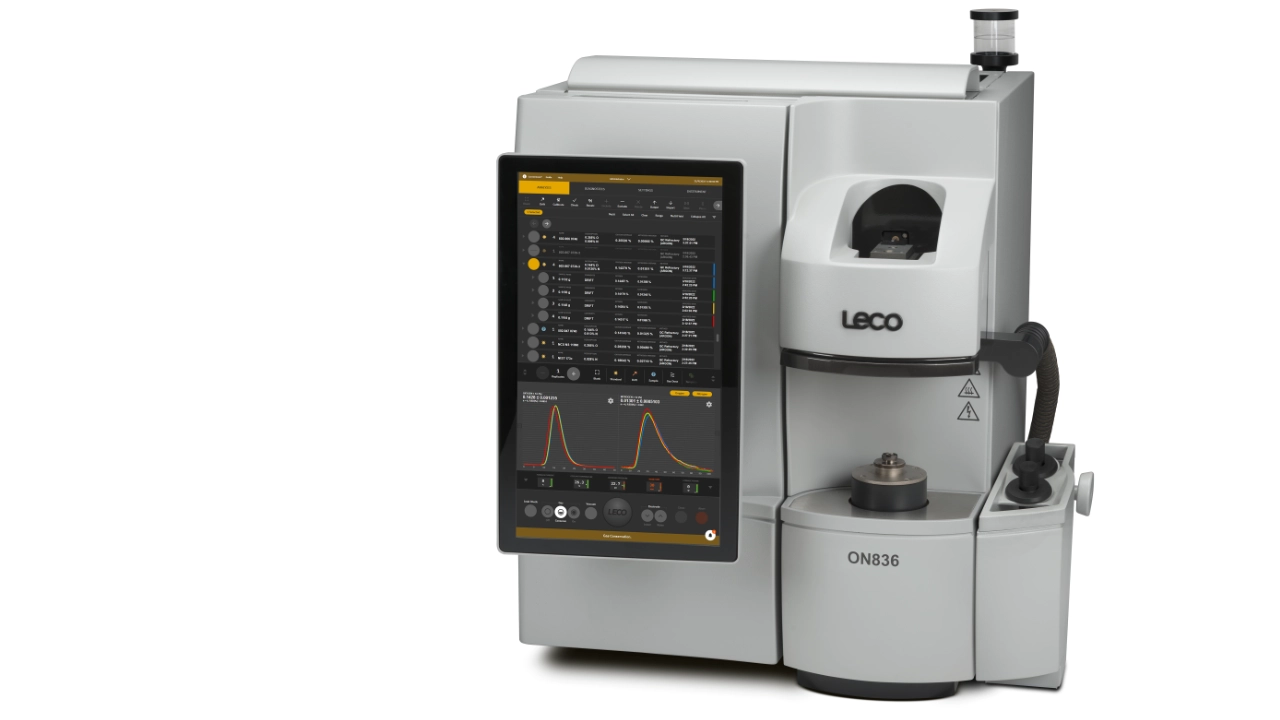
LECO inert gas fusion analyzers for oxygen and nitrogen in inorganic materials (e.g. models ON736, ON836) traditionally use helium as the carrier gas for the preferred TCD when measuring nitrogen. With argon, low-level nitrogen precision is slightly lessened.
736 and 836 models can run on argon, provided the dual-purpose TCD is installed. Once added, switching from helium to argon is a one-time setup change. Both gases are supported in Cornerstone software (select via “Gas Type” setting).
When using argon, the furnace operates at a higher termperature, producing more soot. More frequent maintenance (such as filter changes and cleaning) is required.
Read about using argon as a carrier gas in the 836 Series:
DH603
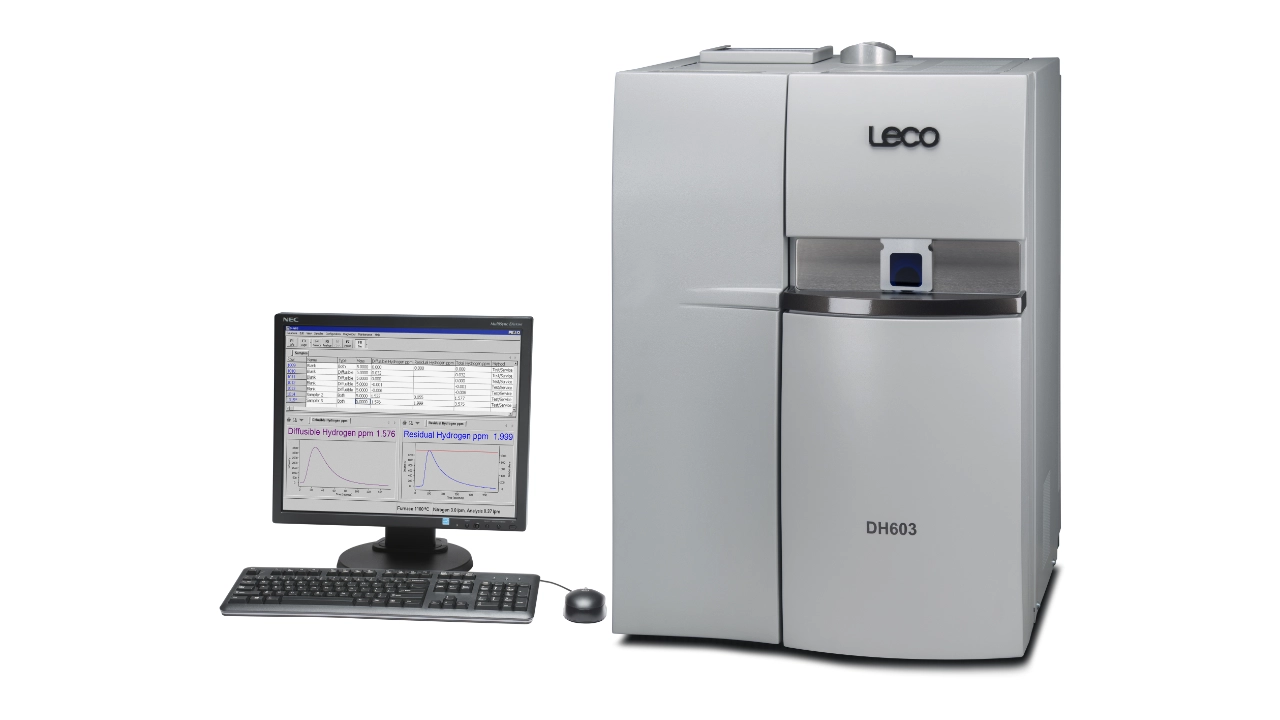
LECO DH603 measures diffusible and residual hydrogen in metals by hot extraction. It does not use helium as a carrier gas during analysis. Nitrogen is utilized as the purge and carrier gas in the DH603 TCD system.
A small helium dose is used only for calibration and system checks, to introduce a known hydrogen quantity via a helium-hydrogen mix.
In routine operation, the furnace is purged with nitrogen and any hydrogen released from the sample is carried to a TCD that references against the nitrogen background. This design avoids flammable gas in the instrument entirely.
Read about how the DH603 operates:



 English
  Spanish
  Japanese
  German
  French
  Portuguese